
B Tech Ed IT Curriculum
We focus on Live, flexible, dynamic, and progressive notion of curriculum. Curriculum is not static, but it should be adaptable according to the time, context, and contemporary changes in the world. Additionally, we emphasize the recent advancement of technology and global perspective of transformative education that aim to develop competent human resources with appropriate soft-skills (21st Century skills) and hard-skills.
Curriculum Credit Hour Calculation
Each course has both Theory and Practical component. This is reflected in the course curriculum, such as 3 credit course = 2 Theory + 1 Practical, 1 Theory + 2 Practical, or 3 Practical!
Theory Component
1 Credit hour = 15 hours of learning engagement!
Practical Component
We must double the teaching-learning hours of students. For example, if your course is of 3 cr. hrs. (2 Th + 1 PR), 15*1 *2 = 30 hours is for practical.
Professional IT Courses-103 Credit Hours
Courses for developing essential IT hard skills and the required 21st-century skills.
Theory Component
64 Credit Hours

Practical Component
39 Credit Hours
Research/Internship-9 Credit Hours
Course for research, innovation, and internship.
Theory Component
0 Credit Hours
Practical Component
9 Credit Hours (100% Practical)
Core Courses-18 Credit Hours
Courses for education foundational and professional skills for educators and tech professional.
Theory Component
12 Credit Hours
Practical Component
6 Credit Hours
Vocational Courses-6 Credit Hours
Courses for developing core vocational skills for educators and tech professionals.
Theory Component
4 Credit Hours
Practical Component
2 Credit Hours
B Tech Ed IT Evaluation/Assessment
The evaluation scheme follows a continuous assessment system (CAS) with an ethos of competency-based assessment. Specifically, the practical components are assessed in the lab, at the workplace, and/or via a learning portfolio. The theoretical components are evaluated via written, oral, demonstration and/or all means
Courses with Major Theoretical Aspect
Internal Assessment = 50%, External Assessment (Final Exam) = 50%
Courses with Major Practical Aspect
Internal Assessment = 75%, External Assessment (Final Exam) = 25%
Tasks & Activities
The following are the major internal tasks students must complete in the course.
Individual tasks that reinforce learning through application beyond the classroom.
Personal reflections connecting theory with experience to promote critical thinking
Structured evaluations assessing conceptual understanding and analytical skills.
Short assessments designed to quickly gauge knowledge retention and comprehension.
Hands-on sessions to develop technical proficiency and collaborative skills.
Applied technical projects integrating theory with lab-based experimentation.
Routine classroom exercises to strengthen practical competencies.
Real-world investigations fostering contextual understanding and data-driven inquiry.
Extended, independent projects demonstrating innovation and technical mastery.
Documentation of workplace-based learning, bridging academic and industry experience.
Oral and visual explanations to convey technical ideas effectively
Interactive peer engagements to co-construct knowledge and solutions.
Oral exams assessing depth of understanding and the ability to articulate ideas.
More than 80% of attendance is mandatory, but regular attendance is required.
Students are active learners and constructor of knowledge. Therefore, students must engage in classroom discussion, inquiry, group-work, and many more.
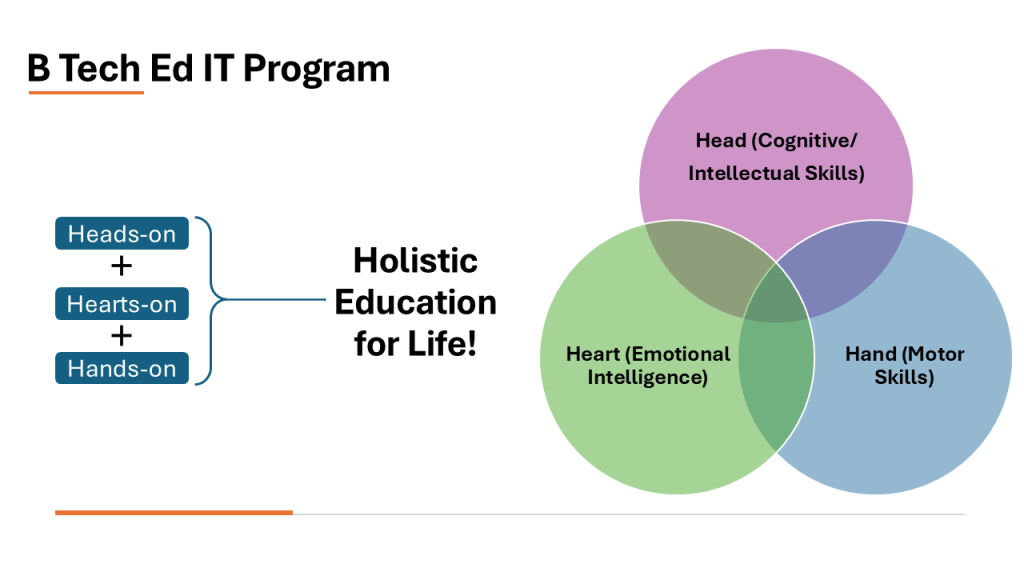
Hands-on, Minds-on, & Heads-on
Project & Practical
Lab experiments in Computer Lab
Structured hands-on sessions to practice, observe, and validate computing concepts and techniques.
Long-term Project Task
Comprehensive, independent work demonstrating sustained technical innovation and problem-solving skills.
Other School for OJT (On the Job Training)
On-the-job training in external schools to apply IT knowledge in real educational settings.
Other Schools for Teaching Practice and Research
Immersive experiences blending classroom teaching with educational research activities.
IT Companies for Fieldwork and Project Tasks
Real-world engagement with industry challenges to apply skills in professional IT environments.
Viva and Presentation
Formal oral evaluations to demonstrate clarity of understanding, articulation, and presentation skills.